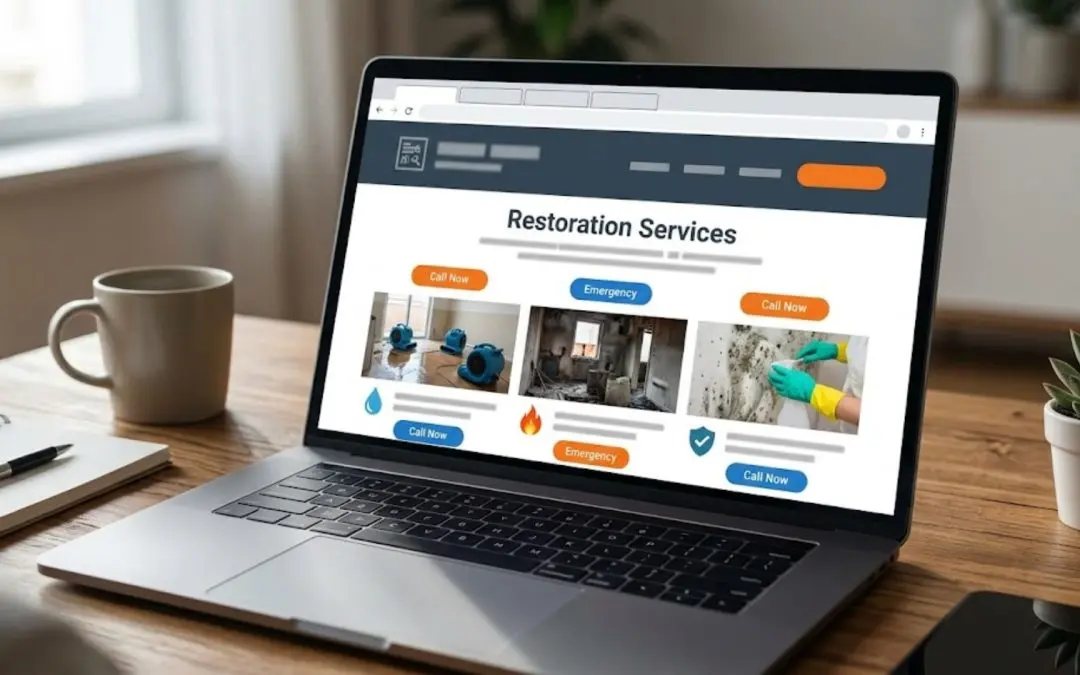
A homeowner with water pooling in the basement does not have patience for a slow, confusing website. They want to know fast whether you handle their problem, whether you serve their area, and how to reach you right now.
That first impression decides whether a referral, a Google search, or a paid ad click turns into a booked job or a call to a competitor. Good website design for restoration companies is not a cosmetic upgrade. It is one of the few marketing assets working for you around the clock.
This article covers the design elements that influence whether visitors convert, the mistakes that quietly cost restoration companies leads, and how to know whether your current site is pulling its weight. We will also cover when it makes sense to bring in a specialist rather than patch things yourself.
A site built five years ago and a site built five months ago face the same test: can a stressed homeowner find what they need, and does the page give them a reason to trust you enough to call.
Why Website Design Matters for Restoration Company Marketing
Restoration is an emergency-driven, trust-driven business. Someone dealing with a flooded basement, a fire, or mold rarely has the luxury of researching for days. They scan a handful of websites and pick the one that looks credible and easy to reach.
That means your website carries weight before you ever speak to the customer. A referral can fall apart if the prospect cannot find enough information about your company online. A paid search click can bounce in seconds if the page does not immediately answer “can you help me, and how do I reach you.”
Jamie Randall, founder and CEO of Restoration Marketing Group, has pointed to real examples of this on the Restoration Success Show podcast, including a case where a multi-million dollar reconstruction project traced back to a simple website inquiry, and another where a contractor lost a referral because the prospect could not find enough proof of the business online. Individual results vary, but the pattern holds across the industry: your website either supports the trust your other marketing builds, or it undermines it.
The Core Jobs Your Restoration Website Needs to Do
Before picking colors or fonts, it helps to define what the site actually needs to accomplish. RMG’s own breakdown of underperforming restoration websites organizes the work into five responsibilities.
Get Found
Your site needs to be structured, and written, so the right prospects can find it through search, maps, and AI-generated answers. That starts with clear service and location information, not just a polished homepage.
Build Trust
Visitors need evidence you can handle their specific problem. Real photos, credentials, service area detail, and reviews all do more work here than a generic stock image ever will.
Convert Visitors
A visitor who trusts you still needs an obvious next step. That means a visible phone number, a simple contact form, and clear calls to action on every page, not just the homepage.
Support Other Marketing
Your website is the destination for every other channel: Google Business Profile, paid ads, social media, referrals, and email. It needs to hold up whatever traffic those efforts send its way.
Improve Over Time
A website is never really finished. Tracking how visitors behave, and adjusting the pages that underperform, is part of the design process, not an afterthought.
Practical Design Tips That Turn Visitors Into Booked Jobs
With those responsibilities in mind, here are the design decisions that make the biggest difference for restoration companies specifically.
Lead With a Clear, Specific Headline
A homepage headline like “Quality Service You Can Trust” could belong to almost any business. Replace it with something specific: the primary service and the service area, stated plainly, followed by a short explanation of who you help and how to reach you.
Give Each Service Its Own Page
Someone searching for mold remediation needs different proof than someone dealing with fire damage. Dedicated pages for water damage restoration, fire and smoke restoration, mold remediation, biohazard cleanup, and reconstruction let each visitor find relevant answers instead of a paragraph buried on the homepage.
Make Contact Effortless
Every page should make it obvious how to reach you. That means:
- A phone number that is clickable on mobile and visible without scrolling
- A short contact form that does not ask for more information than you need up front
- Consistent messaging about availability, including after-hours or emergency response
Show Real Trust Signals
Stock photography and vague claims do not build confidence. Use real project photos, team bios, licensing and certification details, and genuine customer reviews throughout the site, not just on a single testimonials page.
Design for Mobile and Speed First
Most restoration searches happen on a phone, often during a stressful moment. A site that loads slowly or requires pinching and zooming will lose that visitor before they read a word of your copy. Mobile-first, fast-loading design should be the baseline, not an enhancement.
Plan for Emergency Urgency
If you offer a 24/7 emergency response, say so clearly near the top of the homepage and on every service page, paired with a click-to-call button. Any availability claim should reflect what your team can genuinely deliver.
Common Restoration Website Design Mistakes

A site can look modern and still fail at its job. Watch for these recurring issues:
- Homepage copy that is generic enough to belong to any contractor
- Services buried in a single paragraph instead of dedicated pages
- Contact information that is hard to find or missing from certain pages
- Slow load times, especially on mobile
- No visible reviews, credentials, or real project photos
- No clear service area, leaving visitors unsure if you cover their location
How to Measure Whether Your Website Design Is Working
Design decisions should be judged by results, not appearance alone. Track:
- Conversion rate: the percentage of visitors who call, message, or submit a form
- Call tracking data: how many calls originate from your website versus other channels
- Bounce rate and time on page: whether visitors are engaging or leaving immediately
- Page speed scores: using tools like Google PageSpeed Insights
- Mobile usability: whether pages render and function correctly on phones
Reviewing this data regularly, rather than only when something breaks, is what turns a website from a static brochure into a working part of your lead generation system.
When to Bring In a Specialist
Some fixes, like rewriting a headline or adding a review to a page, can be handled internally. Rebuilding site architecture, improving page speed at a technical level, or aligning design with your SEO and paid advertising strategy usually benefits from specialized help.
We built Restoration Marketing Group specifically around damage restoration contractors, and website design is one piece of a broader approach that also includes our SEO services, Google Business Profile management, and online reputation management, so your site works alongside the rest of your marketing instead of in isolation.
Frequently Asked Questions
How much does website design for a restoration company typically cost?
Costs vary widely based on scope, from a few thousand dollars for a template-based rebuild to significantly more for a fully custom site. Factors include the number of service and location pages, custom photography, and ongoing SEO support.
How long does a restoration company website redesign take?
A typical redesign takes several weeks to a few months, depending on the number of pages and how much content needs to be created. Projects that include new photography, copywriting, and SEO structure generally take longer than a simple visual refresh.
Does website design affect SEO for restoration companies?
Yes, design and SEO are closely connected, since search engines weigh page speed, mobile usability, and content structure. A well-designed site gives your SEO strategy a stronger foundation to build on.
Should every restoration service have its own website page?
Generally yes, when your company genuinely offers that service, since dedicated pages let visitors and search engines find specific, relevant information. A page created only to check a box, without real detail, will not perform as well as one built around the customer’s actual questions.
How often should a restoration company update its website?
Plan to review your site at least quarterly, updating reviews, project photos, and service details as they change. A full redesign is usually only needed every few years unless your services or branding shift significantly.
Building a Website That Works as Hard as Your Crew
A restoration company’s website has one job above all others: turning the trust you have already earned into a booked job. That means a clear headline, dedicated service pages, visible contact options, real proof, and a fast, mobile-friendly experience.
One practical next step: pull up your site on your phone today and time how long it takes to find your phone number. If it takes more than a few seconds, that is worth fixing first.
If you would rather have a specialist evaluate and rebuild your site around what actually converts, reach out to Restoration Marketing Group. We work exclusively with damage restoration companies, and website design is one part of how we help partners turn more of their existing traffic into booked jobs.
Recent Comments